
The hairbrush is still full of last night's knots when you walk past the bathroom at 7:12. There is a damp towel on the floor, not on the hook. The soap looks unused. Your child is already in the kitchen, asking about breakfast, hair half-done, face still sleepy, and you feel that familiar tightness: you can do it yourself in ninety seconds, or you can start the reminder loop again.
This is the moment a kids hygiene checklist app is supposed to help, and it is also the moment most paper charts fail. You did not wake up wanting a fight about washing hands. You wanted a short, visible list your child could run without you standing in the doorway. Ages 4 to 6 can hold about 10 to 12 minutes of focused effort. Ages 7 to 9 stretch to 12 to 15. Ages 10 to 12 get 15 to 20 if the sequence is clear. Hygiene does not need a lecture. It needs a sequence that fits those windows, not an adult-sized morning plan.
Common Sense Media found kids aged 8 to 12 average about 5 hours and 33 minutes of screen entertainment a day — not counting school. That is the competition. A wet face and a real toothbrush cannot win if the next step is never named. Harvard researcher George Vaillant's long-running Grant Study found that adults who did chores as children showed stronger life outcomes — a finding Julie Lythcott-Haims popularised in How to Raise an Adult. Hygiene is the smallest daily version of that: wash, brush, flush, hang the towel. Tiny. Repeatable. Easy to skip when you are tired.
Parents say the same thing in different words. Randomly asking kids to do chores does not stick. The list on the kitchen wall gets dusty. Sticker charts last about two weeks. Virtual coins nobody cares about do not move a seven-year-old toward the sink. What they want is age-appropriate tasks, real rewards, and the quiet shift where chores become more like a routine. Ownership, not another round of nagging from the hallway.
Why the bathroom still needs you even after the chart went up
Hygiene is a chain of tiny acts, not one big job. Wash face. Brush teeth. Comb. Deodorant if they are older. Hang the towel. Put dirty clothes in the basket. If you only say "get ready," a child's working memory drops the second shoe. You become the program manager. You carry almost the whole mental load, even when the child "did it." They completed pieces. You still tracked the pieces.
That is why it feels easier to just do it yourself. It is easier, once. Then you do it every morning for years. Charts fail when they are decoration. They fail when rewards are imaginary. They fail when one parent is the only adult who cares. They fail when the list is longer than the child's attention span. A 5-year-old does not need twelve bathroom steps. Three or four, with a 2 or 5 minute timer, is enough. A 10-year-old can own a fuller sequence, still under 15 to 20 minutes, still with a visible next step.
Kids may mark things done without doing them. That is not a moral crisis. It is a design problem. If the only proof is a checkmark, the checkmark will get checked. If the reward is ice cream or a small toy the child actually picks, the work has to be real. Photo proof on a task, approved from your phone, sounds fussy until you realize it keeps the kitchen from turning into a negotiation zone. You are not hovering. You are confirming.
Streaks can help or they can feel like quiet evaluation. Gentle streaks with grace days treat a late night or a fever as normal, not a broken chain. Younger children do not care about long stats. They care that today has a short list and that stars go toward something they chose. That is not bribing if the task is a life skill they will need anyway. It is making the effort visible so you can stop being the family reminder system.
Veja o Sparky em ação
Um mascote, estrelas e recompensas escolhidas em conjunto - numa única app familiar.
How a short hygiene sequence actually runs at home
Pick a time of day and protect it. Morning is usually teeth, face, toilet, clothes in the basket. Evening is teeth, wash, pajamas, towel on the hook. Do not merge them into one giant list. Recurring tasks beat a new speech every day. Autorepeating is the point. The child opens their own screen, sees today's hygiene, and starts. You set it once. They run it.
Keep the language they already use. Age-appropriate chores. Make their own beds every morning if bed-making is on the list, but do not hide hygiene behind a pile of extra jobs. Start with the bathroom. Add hair and deodorant when it is actually relevant. If you have two children, give each a list that matches their age, not a copy of the other's. A 6-year-old and a 9-year-old do not share the same window.
Rewards work when they are consistent, predictable, and tied to effort. Stars toward ice cream, extra story, a small toy, a park stop. Sparky keeps it to stars and a reward the child picks — nothing to unlock before you can even see the list. Parents who have downloaded and deleted a lot of habit apps are tired of virtual coins. They want streaks, stars, no nagging. They want to say, I am no longer the chore tracking app for the family. Shared device mode without a maze of logins matters if the tablet lives on the counter. Ads and subscriptions kill trust fast. Completely free with no ads is the bar many families now set before they even try.
Keep the timer short enough for the actual child in your bathroom, not for an adult doing a 25-minute work sprint. Ten to twelve minutes for the little ones. A visual countdown helps more than a scold. If the timer feels punitive, shorten the list. If interest fades after week two, change the reward with the child, not the whole system. Novelty wears off. Jointly chosen rewards can be updated. That is the small maintenance that paper charts never get.
Here's what the sequence looks like for a family with a six-year-old and a nine-year-old: start the younger child with four bathroom items and a real Friday treat; split morning and evening so nobody faces a wall of text; let each child see progress toward something they actually want. Parents report brushing teeth and washing stop being a fight once the child can see that progress. The change is not a personality transplant. It is a shorter sequence and a reward that is not imaginary.
If you want a simple place to park that list, a tool like Sparky can hold the tasks on the child's screen so you are not the walking checklist. Keep it light. The list still has to be yours, written for your bathroom, your ages, your Friday ice cream, not a stranger's idea of a perfect morning.
Morning hygiene you can hand over (6)
Use the toilet
First thing, before breakfast talk. Flush and close the lid so the rest of the list has a clean start.
Wash hands and face
Soap, water, rinse, towel. If the soap is always dry, this card is the one that finally gets it wet.
Brush teeth fully
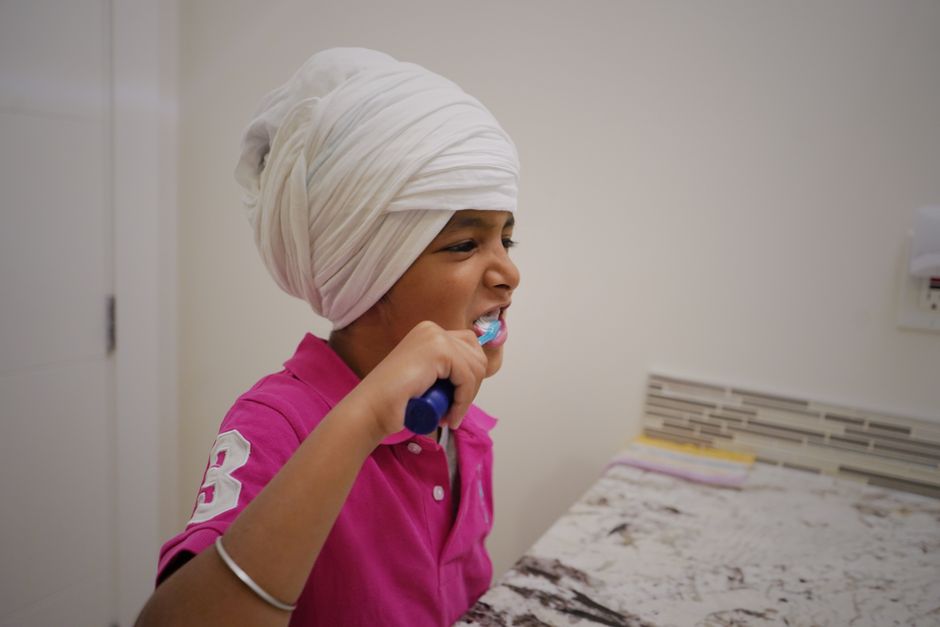
Two minutes, top and bottom, not a quick pass while talking. Put the brush back so it is dry tomorrow.
Comb or brush hair
Start at the ends if there are knots. This is the card that stops the 7:12 hallway rescue.
Pajamas in the basket
Not on the floor, not on the bed. One motion after clothes are on. Small, and it trains the rest of the day.
Deodorant if needed
For older kids only. One swipe, put the stick away. Skip this card until it is actually their season.
Evening hygiene that closes the day (6)
Wash body or shower
Keep it inside a 10 to 15 minute window. Soap, rinse, done. You are not running a spa. You are closing the day.
Night teeth
Same two minutes as morning. This is the one that protects sleep more than any speech about cavities.
Face wash at night
Especially after sports or sunscreen. A washcloth counts. Perfection is not the goal. The habit is.
Hang the towel
Hook, not floor. This one tiny act is how the bathroom stops looking like a storm passed through.
Dirty clothes in hamper
Underwear and socks included. If it lives under the bed, it is not done. The basket is the finish line.
Pajamas on
Last hygiene-adjacent step so sleep can start. No extra chores bolted on. End while they still have energy.
What to do in the next 24 hours, not next month
Write four morning cards and four evening cards. If your child is 4 to 6, cut it to three each. Sit together and pick one real reward for a handful of stars: ice cream, a small toy, extra park time. Not a screen dump that adds to the 6-hour average. Put the list where they can see it without you. Recurring, same order, same timers.
Tell the other adult in the house the same four cards. Multi-parent consistency matters more than any badge. If someone is ill, use a grace day. Do not turn the streak into a performance review. Tonight, run the evening list once without adding extra jobs. Tomorrow, run morning. If they fake a check, ask for photo proof on one task only, the one that used to start fights.
You will still help sometimes. That is parenting, not failure. The aim is fewer reminders, a child who knows the next step, and a bathroom that does not need you as the soundtrack. Hygiene is not a personality trait. It is a short list, repeated, with a reward they actually want, until it feels ordinary. Ordinary is the win.
Baixe Sparky grátis
Acesso antecipado, sem anúncios e sem compras dentro da app - só você e a criança.