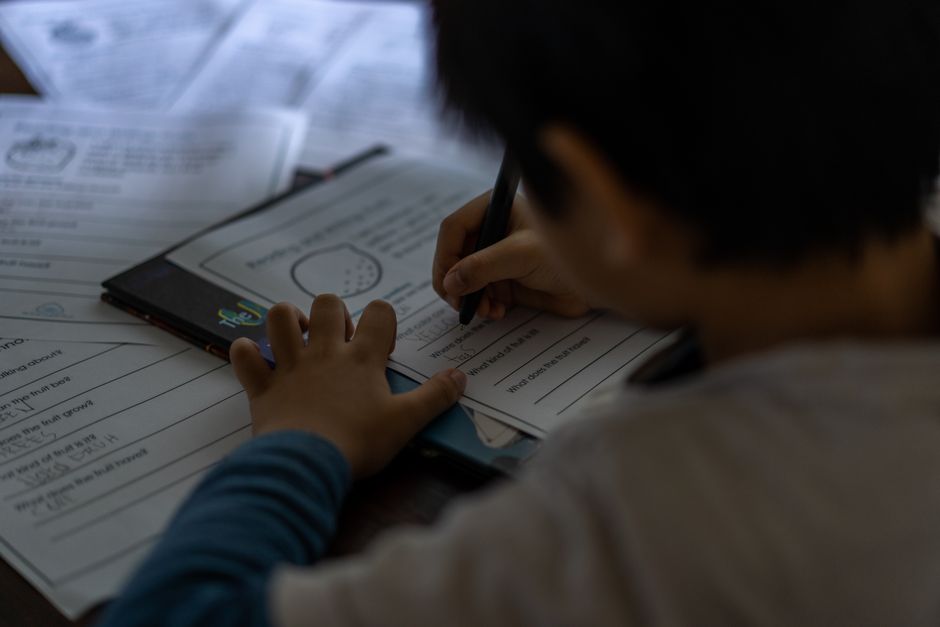
Thursday night, a math worksheet surfaces from the bottom of a backpack, folded into quarters, due the next morning. Nobody mentioned it at dinner, not because anyone's careless, but because homework in most houses lives nowhere until it suddenly lives everywhere, spread across the kitchen table at the worst possible hour, with everyone tired and someone close to tears, and it might not even be the kid. A kids homework habit tracker exists for exactly this moment, not to do the worksheet for anyone, but to give homework a visible, predictable home before it turns into an 8pm emergency. Without one, homework floats. It lives in a teacher's app one week, a crumpled planner the next, and a parent's memory the rest of the time, which means the parent becomes the system. Every "did you do your homework" is a tiny tax on your attention, paid out dozens of times a week, and most parents I've talked to can't actually remember when they became the human reminder app for their own kid. The research backs up what you already feel in your body by 7pm: kids ages 8 to 12 now average 5 hours and 33 minutes of entertainment screen time a day, not counting schoolwork, and that time is competing directly with the 15 to 20 minutes homework actually needs. A tracker won't fix a hard math unit or a tired kid. What it can do is take the nagging out of your hands and put the routine where your child can actually see it, which is the first real step toward them owning it instead of you.
The real reason reminders stop working by week two
Here's the pattern almost every parent describes, almost word for word: the chart goes up, the kid is thrilled for about ten days, and then it's dusty on the kitchen wall by week three. It's not that the child lost interest in stars. It's that the chart only ever tracked the outcome, "homework done, yes or no," which means on the one night it doesn't get done, the whole system just stops telling you anything useful. A kids homework habit tracker that actually survives needs to track the process, not just the finish line. That means noticing when the backpack gets opened, when the workspace gets set up, when the timer starts, not only whether the last page got checked off. Kids who struggle with homework usually aren't struggling with the subject itself as much as with the five invisible steps before they even sit down: finding the folder, finding a pencil, finding a chair that isn't also where a sibling is doing something louder and more interesting. If your tracker skips straight to "homework complete," you're asking your child to succeed at a six-step process while only ever tracking step six.
There's also the screen time problem sitting underneath all of this. With 42% of ten-year-olds already carrying a smartphone, and that number climbing to 71% by age twelve, the device competing for your child's 4pm attention is often sitting in their own pocket. Nearly half of parents say they lean on screens daily just to get through the afternoon, which is completely understandable and also exactly why homework needs its own protected slot, not a slot that has to fight a tablet for airtime. A tracker that visually marks "homework time" as its own thing, separate from free time, gives a kid something concrete to point to when a sibling asks them to come watch something. It's not a lecture about screens. It's just a line on a screen they already trust, telling them what comes first.

Veja o Sparky em ação
Um mascote, estrelas e recompensas escolhidas em conjunto - numa única app familiar.
Matching the tracker to how long your child can actually focus
One detail that gets skipped in most homework advice: a nine-year-old's attention span is not a smaller version of an adult's. Kids aged 7 to 9 genuinely focus well for about 12 to 15 minutes at a stretch before their brain needs a reset, and for ages 10 to 12 that window stretches to maybe 15 to 20 minutes. Younger kids, 4 to 6, are realistically good for 10 to 12 minutes. If your homework tracker (or your own expectations) assume a single 40-minute sit-down block, you're setting your child up to fail at something that was never about effort in the first place. This is where a lot of adult productivity tools, Pomodoro timers built for grown-ups, miss the mark badly for kids. A 25-minute focus block makes sense for you at your desk. It's brutal for an eight-year-old doing spelling words.
What works better is breaking homework into chunks that match the actual window, with a visible countdown your child can watch rather than guess at. A short burst, a stretch break, another short burst. For a nine-year-old with three worksheets, that might look like two 12-minute blocks with a five-minute break for a snack in between, tracked as two separate wins rather than one long slog. This is also where real rewards beat virtual ones by a wide margin. Parents say it plainly, over and over: "virtual coins nobody cares about" don't move the needle, but a reward a child actually picked, an extra ten minutes before bed, a small treat, a sticker toward something real, does. The tracker's job isn't to gamify homework into a video game. It's to make the invisible parts visible and give small, honest credit for showing up to each chunk, not just the final grade on the page.
Building a homework routine that bends instead of breaking
Every homework routine eventually meets a bad Tuesday. A sick day, a late soccer practice, a meltdown over nothing in particular. The habit trackers that actually last are the ones built with room for that from day one, sometimes called grace days, where missing a night doesn't wipe out the whole streak and doesn't need to feel like a failure either. This matters more than it sounds like it should, because a streak that snaps the moment life gets messy teaches a kid that the whole system was fragile to begin with, and fragile systems get abandoned fast. A gentle streak, one that can absorb a rough night without collapsing, keeps the motivation light instead of turning every evening into a performance review.
In practice, building this looks like a short, honest conversation rather than a big launch. You might sit down with your child and ask what the homework routine should actually include, in their words, not yours. One family with a nine-year-old who, in his mother's words, "really struggles with routine, being active, and chores," found that letting him help build the checklist, backpack unpacked, snack first, timer set, workspace clear, mattered more than any sticker on the page. He wasn't following her rules anymore. He was running his own list. That shift, from parent-enforced to child-owned, is really the whole point of a tracker in the first place. This is roughly where an app like Sparky fits in quietly: the parent sets the homework task once, the child sees it on their own screen each afternoon, and the reminder stops living exclusively in a parent's head. No ads, no subscription, no leveling up a cartoon character, just a visible task and a star that means something because a real reward is waiting on the other side of it.
Three things to try before next Friday
If your evenings currently involve some version of the backpack hunt, here's where to start, in order, without overhauling everything at once.
- Pick one fixed homework slot this week, right after a snack or right after a short break from school, and keep it in the exact same spot every day so your child stops wondering when it's coming.
- Break the work into chunks that match your child's actual attention span, roughly 12 to 15 minutes for a second or third grader, with a short visible break in between rather than one long sit.
- Choose one real reward together, something your child picked, not something you assume they'll like, and make the connection between finishing the routine and earning it obvious and immediate.
- Build in at least one grace day a week from the start, so a missed night doesn't feel like the whole thing failed and doesn't need rebuilding from scratch.
- Let your child see the full routine, not just the homework itself, so backpack, workspace, and timer all count as real steps worth noticing, not just the final checkmark.
None of this needs to be perfect by Monday. Start with the fixed time slot alone if that's all you can manage this week, and add the rest once that one piece holds. The goal was never a flawless chart on the wall. It's the quiet version of success, the night your child sits down with their folder without being asked twice, because the routine finally belongs to them and not to you.
Baixe Sparky grátis
Acesso antecipado, sem anúncios e sem compras dentro da app - só você e a criança.