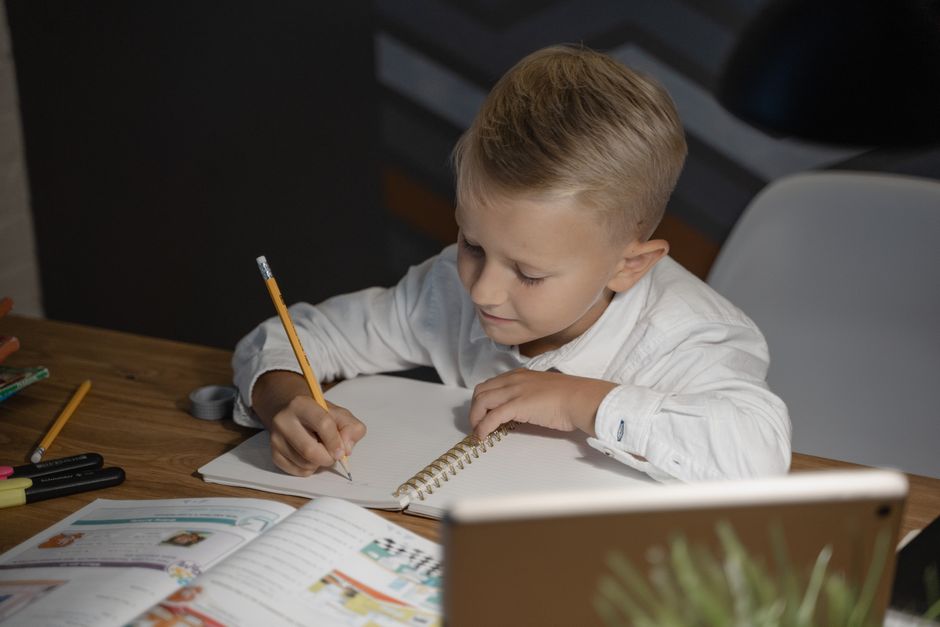
The school bag is already on the floor when you walk in. A crumpled worksheet peeks from the zipper. Your child is hungry, a little loud, and already asking about a show. You still have dinner, a younger sibling, and that email you never sent. Homework is not even a conversation yet, and you can feel the evening tightening around it.
A homework planner for kids is not a pretty calendar on the fridge. It is a small, visible plan for the next 20 to 40 minutes: what comes first, how long it lasts, and what happens when it is done. Without that, you become the planner. You hold the sequence in your head, you remember the spelling list, you guess how long math will take, and you start the reminders before anyone has sat down.
Kids ages 8 to 12 average more than five and a half hours of entertainment screen time daily—not counting schoolwork—according to Common Sense Media's 2021 Census. That is the competition for the short window after school. Pediatric focus is narrow too: about 10 to 12 minutes for ages 4 to 6, 12 to 15 for 7 to 9, and 15 to 20 for 10 to 12. If the plan is “do your homework,” it is too big for those windows. If the plan is three short blocks with a snack in between, a tired child can start.
You do not need a perfect system. You need something your child can see without asking you what is next. The rest of this piece is how that looks on a real Tuesday, not in a catalog of productivity tools.
When “do your homework” is too big to start
One mother of an eight-year-old described the same stall every afternoon. The child would sit, open the folder, and freeze. Nothing was wrong with the math. The problem was the pile. Reading, a worksheet, and a project all lived in one vague job. Starting felt like agreeing to an unknown amount of time, so the child delayed, asked for water, and waited for you to break it down out loud.
That stall is not laziness. It is a reasonable reaction to an unbounded task. Adults do the same with a messy inbox. Kids just have less language for it, so it comes out as “I don’t know” or “later.” If you keep answering “later” with more words, you stay the homework planner for kids in human form. The child never has to hold the sequence.
Try naming the pieces before anyone sits. Not a lecture. Three lines, said once, maybe written where they can see them: snack, ten minutes of math, five minutes of reading. If there is a project, it does not belong in the same sitting as the worksheet. Projects eat evenings. Worksheets need a start and a stop.
Keep the first block shorter than you think. Fifteen minutes of focused work for a nine-year-old is a win. Twenty is the upper end for many ten- to twelve-year-olds after a long school day. If you plan an hour, you are planning a fight. If you plan two short sits with a stretch in the middle, you are planning a finish.
Parents often say it is easier to just do it themselves. Sometimes that is true for one night. Over a month, you teach the child that homework is something that happens to them when an adult is free. A planner, even a crude one, teaches the opposite: this work has a shape, and the shape belongs to them.
Guarda Sparky in azione
Una mascotte, stelle e premi scelti insieme - in un'unica app per la famiglia.
Build the afternoon in blocks a child can close
Start from the door, not from the desk. The first five minutes after school are not academic. Jacket, snack, bathroom, a short reset. If you skip that, homework inherits the leftover energy from the bus and the playground. A planner that begins with “sit down now” ignores the body.
Then write only what will actually happen today. Recurring work belongs on a repeating list: reading minutes, math practice, packing the bag. One-off work belongs as its own line: the poster, the book report, the form you forgot to sign. Mixing them makes everything feel like a surprise.
Match the timer to the age, not to the adult Pomodoro you use at work. A six-year-old can often close a 10-minute block if the page is already open. A ten-year-old can often do 15 to 20 if the phone is in another room. Visual countdowns help more than “until dinner.” Kids need to see time moving, not hear you announce it.
Put the order in the child’s words. “Math first because it is loud in my head” is a better plan than “we always do reading first.” Ownership starts at the sequence, not at the grade. You still set the non-negotiables: school work before screens, bag packed before bed. They choose which subject goes first inside that fence.
Protect the 15 to 20 minutes the way you would protect a doctor appointment. Children 8 to 12 already spend more than five hours a day on entertainment screens. Research on childhood responsibility habits consistently links small daily tasks—done consistently—with stronger self-regulation in adolescence. Homework is one of those small daily responsibilities. It does not need to be grim. It needs a protected slot so it is not always the leftover after a show.
If you want a tool that lives on the child’s screen instead of in your mouth, keep it simple: a few tasks, stars toward a real prize they picked, no extra login drama. Some families use Sparky that way for after-school work and packing, because the child can mark a block done without you standing in the doorway. The planner still has to be yours together. The app is only the list they can see.
What to put on the page so it survives week three
Paper charts often last about two weeks. Parents say the kitchen list went dusty. Apps get downloaded and deleted. Virtual coins nobody cares about do not pull a tired child through fractions. If your homework planner for kids is going to last, the rewards have to be real and the tasks have to be small enough to finish without a speech.
Write tasks a child can close without you inspecting every line. “Open math page 14 and do the first five” is finishable. “Study for the test” is not. “Read for 12 minutes” is finishable. “Be a better reader” is not. The child should know, without asking, what done looks like.
Use a short list, not a life plan. Three after-school items is plenty for most elementary kids:
- The academic block that is due tomorrow, timed to their real attention span, not to your hope that they will suddenly love worksheets.
- The pack-the-bag step, because tomorrow’s fight often starts tonight with a missing folder.
- One tiny reset, like putting the pencil case back, so the next afternoon does not begin in a hunt.
Tie stars or checkmarks to effort and completion of the block, not to a perfect score. Carol Dweck's praise research at Stanford found that children rewarded for effort—not for correct answers—showed greater persistence and resilience on harder problems. The same principle applies here. A child who sat for 15 minutes and asked for help did the job. A child who copied answers in two minutes and ran to a tablet did not. You already know the difference. The planner should not pretend otherwise.
Let the child pick the prize before the week starts. Ice cream, a small toy, extra time with you, a later Saturday breakfast. Parents who switched from virtual coins to something the child actually wanted report fewer fights, including over brushing and reading. Homework is the same psychology. If the prize is vague, the work stays vague.
Build in ordinary life. Illness, late sports, a hard day. Gentle streaks with a grace day beat a number that turns into quiet evaluation. Consecutive-day pressure is an adult sport. Kids need routines more than they need a perfect chain.
Two adults in the house need the same plan. If one parent lets screens start “just for a minute” and the other holds the homework block, the child learns to shop for the easier adult. Write the rule once. Stick it where both of you will see it. Multi-parent consistency beats any sticker.
Your next three afternoons, kept ordinary
Tonight, do not rebuild the whole year. Sit with your child for five minutes and name tomorrow’s blocks. One subject. One timer that matches their age. One finish line they can see. Put screens after the block, not as a bribe you negotiate in the moment.
Tomorrow, start from the door. Snack first. Then the short sit. You can stay nearby without narrating every problem. If they stall, point at the plan, not at their character. “Math is first. Ten minutes.” That is enough words.
The day after, add packing the bag as its own closeable job. That is the piece that saves the morning. If they mark it done and the folder is still on the table, you do not need a speech. You send them back to the one step. Kids sometimes tap done without doing the work. A calm return to the actual bag teaches more than a lecture about honesty.
You will still have messy Tuesdays. Some nights you will do more than you wanted because the project is due. That does not mean the planner failed. It means school is lumpy. The win is the ordinary days, when your child knows the order, sits for a short block, and you are not carrying the whole sequence in your head.
The bag will still land on the floor. Some evenings will still be loud. But if your child can look at three lines on the fridge and know what comes next without asking you, you have already done the hardest part.
Scarica Sparky gratis
Accesso anticipato, niente pubblicità e niente acquisti in-app - solo tu e tuo figlio.