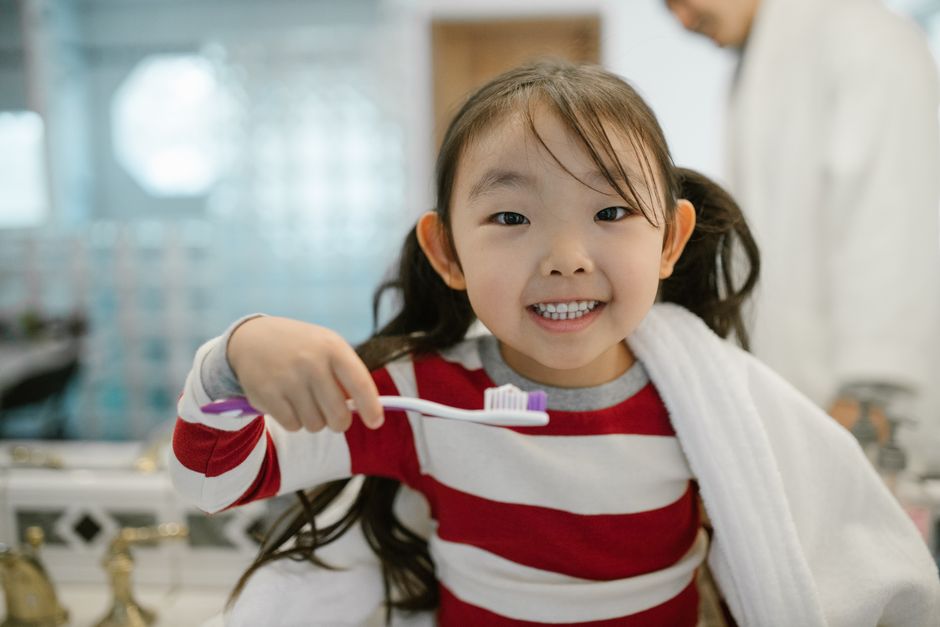
Dinner plates are cleared. Someone is already arguing about who left the towel on the floor. You send your child toward the bathroom with the usual short list - brush, rinse, wash face - and for a second you believe tonight will be different. Thirty seconds later the faucet runs, stops, and the door stays half open. You hear nothing useful. When you check, the toothpaste cap is still dry and the brush sits exactly where it sat this morning.
They know the sequence. They have known it for years. What they are waiting for is not information. They are waiting for your voice to start the machine. That is the quiet trap behind every kids hygiene routine app search, every sticky note on the mirror, and every night you stand in the doorway asking the same three questions. The gap is not knowledge. It is initiation. Until the child owns the start, you stay the living checklist - and hygiene keeps feeling like a second job after a long day.
If that sounds familiar, you are not failing at parenting. You are carrying a load the routine was never meant to put on one adult. The rest of this piece is about why that happens, what keeps the dependence in place, and how a careful handoff actually looks when you stop performing the steps out loud for them.
They can name every step and still not begin
Ask a seven-year-old what comes after dinner and most can rattle it off without blinking: pee, brush top and bottom, spit, rinse, wash hands, maybe a quick face wipe. The knowledge is there. What stalls is the first move - the moment between finishing a show or a snack and actually walking into the bathroom with purpose.
School-age kids often freeze at start-up, not at content. Time blindness plays a part. Five minutes of brushing feels endless when a sibling is still playing in the next room. Sensory pushback is real too. Some kids hate the mint burn, the wet collar, the feel of water on their face, or the way hair sticks after a rushed wash. Sibling traffic adds another layer. If the bathroom is a contested zone, delaying becomes a strategy, not laziness.
One mother of a six- and nine-year-old described it this way: “They could teach a class on brushing. Then I would find the toothbrush bone-dry and both of them still in pajamas at 8:40.” A dad who used to do three bathroom rounds every night said the pattern only shifted when he stopped narrating the list from the hallway. Until then, the children treated his voice as the official start button.
That is knowledge without initiation. You can explain the why a hundred times. You can draw the order on a whiteboard. If the child never has to open the sequence themselves, the brain files hygiene under “things that begin when Mom or Dad appears.” The work of parenting then becomes endless restarts instead of occasional coaching.
See Sparky in action
A mascot, stars and jointly-chosen rewards - in one family app.
How your reminders quietly train them to wait
Every prompt teaches something. The first “Did you brush?” is helpful. The third one is a habit - for both of you. Your child learns that the real signal is not the clock or the finished plate. The real signal is your tone from the doorway. You learn that silence usually means unfinished work, so you keep checking. The loop tightens.
Paper charts and fridge lists often join that loop for a short stretch. They look organized. Kids color a star. Then the sheet blends into the kitchen wall, the markers dry out, and you are back to verbal policing. Most parents we hear from report charts hold attention for one to two weeks before the novelty fades—and then the parent is back to verbal reminders. The chart did not fail because kids are lazy. It failed because the parent still held the mental load - noticing, prompting, verifying, resetting the system when someone forgot.
There is also the honesty gap. “I already did it” can mean a two-second rinse, soap that never touched water, or a full effort on a good night. Without a clear way for the child to mark completion and for you to step back on purpose, you stay in inspection mode. That mode feels responsible in the moment. Over months it builds dependence. Your child is not building a hygiene routine. They are building a response pattern to your voice.
None of this means you should stop caring about clean teeth or washed hands. It means the current system is training the wrong skill. The skill you want is simple and hard at the same time: initiation, then ownership, then proof the child can see. They start. They run the short list. They mark it done. You coach the edges instead of living inside every step.
Bathroom reality that charts ignore
Hygiene is not a calm workshop. It is wet floors, competing siblings, school mornings with eight minutes left, and evenings when everyone is already tired. A rushed wash before the bus looks nothing like a calm Sunday night. A shower that only starts after three knocks is not a character flaw. It is often time blindness plus the pull of whatever felt more interesting thirty seconds ago.
Attention windows for this age are short. Research on sustained attention suggests most kids this age drift after about one focused task, and parents commonly see the same pattern in the bathroom—once toothpaste, hair, and soap all have to happen, screens or books pull harder. Children ages 8 to 10 already average around six hours of screen time a day, according to American Academy of Pediatrics reporting on common screen-time patterns. Habit windows compete with that pull every single evening. If hygiene only exists as your spoken list, it loses.
Sensory friction deserves respect too. Forcing a mint flavor a child hates, or insisting on a long shower when cold air hits wet hair, turns the bathroom into a fight zone. A simple swap—unflavored toothpaste or a bubblegum flavor for a mint-sensitive kid—can remove the nightly standoff without turning the routine into a negotiation every time. Ownership grows faster when tasks are age-fit and slightly adjustable: a milder paste, a shorter face wash on school nights, a clear end point so water play does not become the whole event. If sensory pushback is intense, persistent, or paired with broader daily struggles, that is worth an occupational therapy consult; for many kids, though, a small product or timing change is enough.
The goal is not a perfect bathroom performance. The goal is a child who can look at their own short list, begin without a parent monologue, and finish with something you can trust more often than not. That is a different job than “make them clean.” It is teaching them to carry the sequence when you are not standing there.
What actually transfers ownership past week two
Casual attempts usually look like this: you yell the list from the kitchen, print one more chart, try stickers for a burst of enthusiasm, then quietly resume doorway checks when the novelty dies. Doing it properly is slower and more deliberate. You pick fewer tasks. You write them in the child’s words. You agree on one small, real reward together. You put the list where they open it - not only where you can police it. Then you practice stepping back on purpose for one evening and review what stalled without turning it into a lecture.
The pattern that actually sticks has three parts: the child starts on their own, they run the steps themselves, and they mark it done in a way you can trust. Initiation means the child starts from their list, not from your third reminder. Ownership means the steps live on their side of the routine - their screen, their chart they chose to open, their sense that this is their job. Proof means they mark done in a way that reduces the need for you to inspect every bristle. You still stay available. You just stop being the default alarm.
What tends to last is not more color on the fridge. It is jointly chosen rewards the child actually wants—paired with gentle progress markers like stars or short streaks that feel good instead of heavy. A nine-year-old who chose staying up 20 minutes for a chapter book held her streak for 11 days; a six-year-old who picked Friday ice cream with Dad kept going for three weeks. Virtual coins nobody cares about fade fast. Real, predictable rewards tied to effort hold longer. When the child can see progress toward something they picked, the routine starts to feel like theirs.
Here is a short ordered sequence you can run this week without buying anything new:
- Pick three to five hygiene tasks maximum for one part of the day - evening teeth and wash, or morning face and brush - so the list fits a real attention window.
- Rewrite each task in kid language they would actually say out loud, such as “brush top teeth,” “rinse and spit,” “wash hands with soap,” not adult shorthand.
- Sit down once and agree on one small reward you both can live with, something concrete and soon enough to matter.
- Put the list where the child opens it first - their own view, not only a parent clipboard or a high shelf you control.
- Practice one prompt-free evening: state the plan once after dinner, then leave the bathroom doorway empty on purpose.
- The next day, review what stalled with curiosity, not shame. Adjust one task or one timing detail. Keep the handoff.
That last part matters. If the first prompt-free night is messy, the answer is rarely “go back to three doorway checks forever.” The answer is usually a clearer task, a shorter list, or a reward that still feels worth the effort. Ownership is built in imperfect evenings, not perfect ones.
Some families find it easier when the child-facing list lives on a simple screen the kid controls, with stars and a reward they helped choose, so the parent is not the only system holding the sequence. Sparky is built around exactly that idea—tasks the child opens on a child-controlled interface, gentle streaks, and reward customization they help choose—which can cut the reminder load when you are ready to step back on purpose. It is not magic. It is structure on their side of the bathroom door.
You already know your child can name the steps. The work now is quieter and more useful: hand them the start. Rewrite three hygiene tasks in their words tonight. Let them run one evening without your voice as the checklist. Notice what happens when the list is theirs to open. That single shift - from your reminder to their initiation - is how hygiene stops being a nightly second job and starts becoming a routine they can carry.
Download Sparky free
Early access, no ads and no in-app purchases - just you and your child.