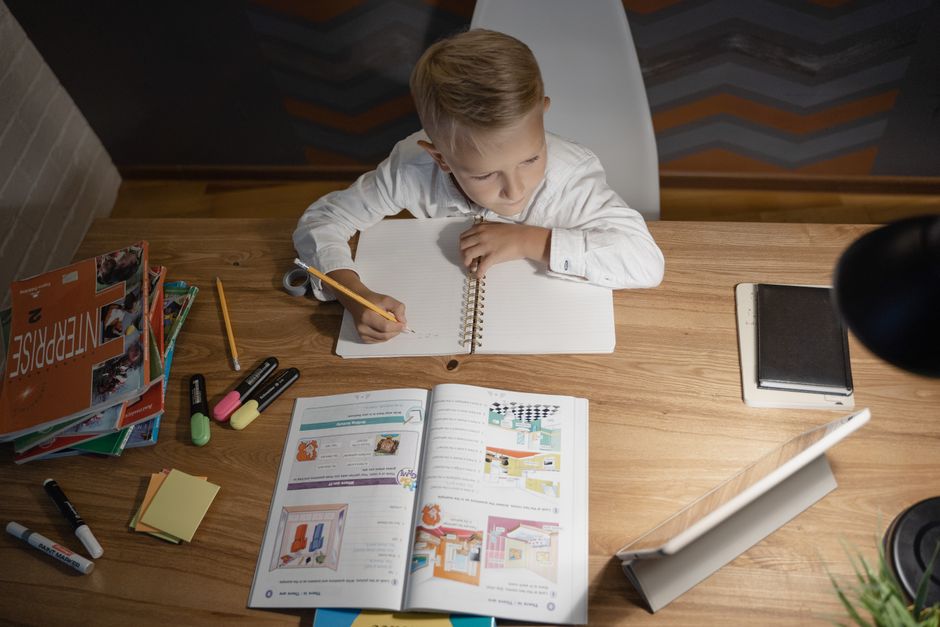
"Do you have homework tonight?" "Nope." Forty minutes later, right before bed, a reading log turns up half-finished at the bottom of a backpack, due the next morning, unsigned. If that exchange sounds familiar, you're not alone, and you're not doing anything wrong. A kids homework planner app exists precisely for this gap: the space between what a child says is done and what's actually due. It's not about adding more screen time to a day that already has plenty of it. It's about giving homework a home that isn't your memory, your phone's notes app, or a crumpled note you find three days too late.
Most families don't need a homework system because their kid is lazy or disorganized in some deep, worrying way. They need one because a nine-year-old's brain genuinely can't hold "math worksheet, spelling list, permission slip, and library book due Friday" in working memory the way an adult's can. Executive function, the mental skill that handles planning and sequencing, is still developing well into the teenage years. Asking a child to just remember everything is asking them to do something their brain isn't built to do reliably yet. A planner, digital or paper, takes that job off their head and puts it somewhere visible.
Why "did you do your homework" stops being a useful question around third grade
Here's the thing about that question: it has exactly two possible answers, and neither one gives you information you can act on. "Yes" might mean finished and checked, or it might mean "I did the first three problems and got bored." "No" might mean forgotten, or avoided, or genuinely not assigned that day. By the time kids are juggling multiple subjects and multiple teachers, usually around second or third grade, the question has stopped doing its job. What you actually need to know is specific: what's due, how much is left, and whether your child has what they need to finish it.
A written or digital list answers that automatically. Instead of interrogating your child at 7pm, you both just look at the list. One mother of an eight-year-old described switching from nightly check-ins to a simple shared list taped near the kitchen table, and said the biggest change wasn't that homework got done faster. It's that the conversation stopped being an interrogation and started being a glance. "Two left, fifteen minutes" is a very different evening than "did you, did you not, show me your folder."
This is also where a lot of chore and routine apps fall short for homework specifically. They're built for recurring daily tasks like brushing teeth or making a bed, which repeat the same way every day. Homework is messier: it changes daily, varies by subject, and sometimes doesn't exist at all on a given night. A planner built for this needs to let a parent or child add, edit, and clear tasks quickly, not just check off a fixed list.
See Sparky in action
A mascot, stars and jointly-chosen rewards - in one family app.
Breaking one big assignment into pieces a kid can actually finish
Pediatric attention research gives a useful, specific number here: kids aged 7 to 9 tend to hold focus well for roughly 12 to 15 minutes at a stretch, and kids aged 10 to 12 can usually manage 15 to 20 minutes before they need a break. That's not a flaw in your child. It's the normal shape of their attention at that age. The mistake a lot of homework routines make is treating a 40-minute assignment as one block, which guarantees a meltdown somewhere around minute 18.
A planner works better when it mirrors that attention span instead of fighting it. Break "finish the worksheet" into "do the first ten problems," then a short break, then "finish the rest." Break "read for 20 minutes" into two 10-minute sessions if that's what actually gets read. This isn't lowering the bar. It's matching the task to the tool your child has, which is a brain that genuinely cannot sustain unbroken focus for 40 minutes at age eight, no matter how many times you ask it to.
In practice, that might look like this:
- Write the full assignment down first, exactly as the teacher gave it, so nothing gets lost in translation.
- Split it into chunks that match your child's age: smaller pieces for younger kids, slightly longer ones as they get older.
- Add a short, visible timer or countdown for each chunk, so "work for a bit" becomes "work for 12 minutes," which is far easier for a child to picture and finish.
- Let your child check off each piece themselves as they finish it, rather than you announcing "good job" from across the room. That small act of checking something off matters more than it looks like it should.
Some families do this with a notebook and a kitchen timer, and it works fine. Others prefer something that lives on a screen, partly because kids this age are already comfortable with screens and partly because a digital list doesn't get left in the car or soaked in a water bottle spill. This is one of the places an app like Sparky can quietly help, since a child can see their own homework tasks laid out in order on their own screen, check them off as they go, and feel the small satisfaction of finishing without a parent hovering over every step.
Keeping two or three kids' homework straight without becoming the planner yourself
In a family with two or three kids at different grade levels, homework tracking gets complicated fast. One child has a spelling test Thursday, another has a science project due in two weeks that needs supplies bought this weekend, and a third just needs to read for 20 minutes a night. If all of that lives in your head, you become the single point of failure for every assignment in the house, and you will eventually drop one. That's not a character flaw. That's just math.
The fix isn't a more complicated system. It's separating each child's list so each one only sees their own tasks, in language and detail appropriate to their age, instead of a shared family whiteboard that nobody really owns. A six-year-old doesn't need to see a sibling's science project deadline cluttering their list; they need "read with mom for 10 minutes" and nothing else competing for their attention. A twelve-year-old, on the other hand, can usually handle seeing the whole week laid out, including the project due in two weeks, because they're capable of pacing themselves across days if someone shows them how once or twice.
Multi-parent consistency is the other quiet failure point here. If one parent updates the list and the other doesn't know it exists, you end up with two separate mental tallies and a kid who's learned that asking either parent eventually gets them out of doing the work, because the information never quite lines up. Whatever system you use, both parents (or a parent and a grandparent, in plenty of households) need to be looking at the same list. That single change, more than any clever reward system, is usually what stops one adult from becoming the permanent homework tracker for the whole family.
What actually keeps a homework routine running past the first two weeks
Chore charts and homework planners share the same failure pattern: enthusiastic for about two weeks, then quietly abandoned. The novelty wears off, the stickers stop feeling special, and everyone slides back into verbal reminders. What tends to survive past that point isn't a fancier system, it's smaller friction and real stakes. Real rewards, chosen by the child rather than assigned by the parent, hold attention far longer than points or badges that don't convert to anything. A ten-year-old who's working toward a specific thing they picked, whether that's twenty minutes of a favorite show or a small toy, checks their list far more reliably than one working toward an abstract streak number.
Grace matters too. If a child is sick, or there was a late practice, or homework genuinely didn't get assigned that night, the system should treat that as normal rather than as a broken streak. A planner that punishes an ordinary off night the same way it punishes real avoidance teaches kids to fear the tool instead of using it. The goal was never a perfect, unbroken chain of checkmarks. It was a child who, most nights, knows what's due and handles it with less back-and-forth than before.
And here's the honest part: no planner, app or paper, replaces a parent entirely. There will still be nights you sit next to your kid and work through a confusing math problem together. That's not the system failing. That's just parenting. What a good homework planner does is handle the part that doesn't need you, the remembering and the listing and the checking off, so the part that does need you, the actual help with the actual problem, gets more of your patience instead of all of it being used up on "did you even start yet."
Start small this week. Write down exactly what's due for one child, for one night, broken into two or three pieces. Let them check off the first piece themselves and see what happens to the mood in the room. It's a small thing, but it's usually the small thing that sticks.
Download Sparky free
Early access, no ads and no in-app purchases - just you and your child.