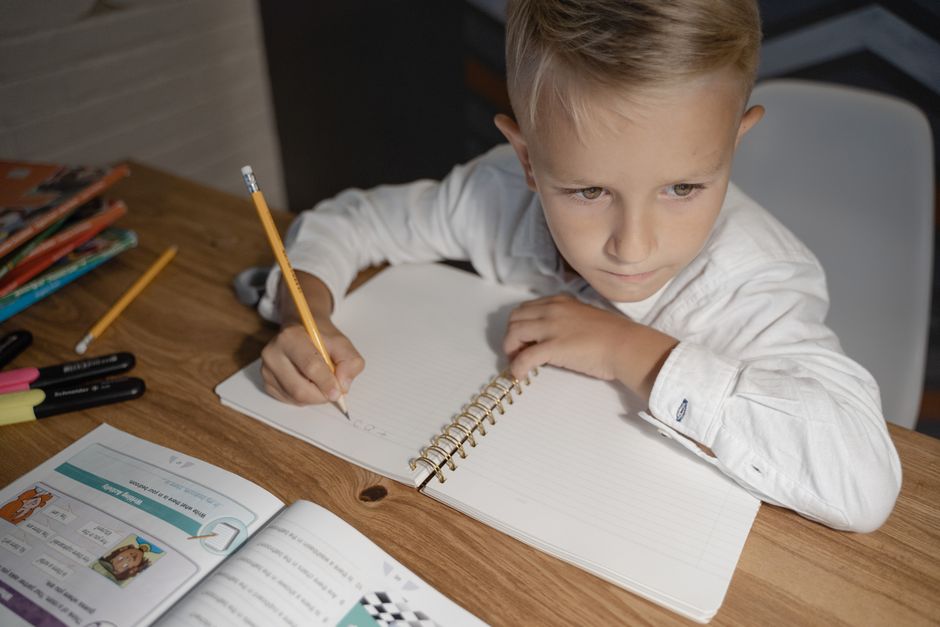
The backpack slides under the chair and your nine-year-old is already asking about the tablet. You know there is a worksheet in there. You also know the next twenty minutes will go one of two ways: calm start, or a slow grind of “in a minute,” “I forgot,” and you hovering with the same three questions you asked yesterday.
That is the moment a homework habit tracker for kids stops sounding like a fancy chart and starts sounding like relief. Not another wall poster you rewrite every Sunday. Something your child can see, start, and finish without you becoming the human timer, the scorekeeper, and the closing argument.
Homework is different from making a bed. It collides with hunger, leftover school energy, sibling noise, and a brain that already spent hours sitting still. Common Sense Media found kids aged 8–12 average nearly five hours of entertainment screen time daily — outside any schoolwork. Those numbers do not make you a bad parent. They do mean the short window after school is crowded. Research and classroom experience suggest sustained focus in elementary-aged kids often runs 2–3 minutes per year of age — so plan for 15–20 minutes for a 7–9 year old and 20–25 for a 10–12 year old before a break (Zentall & Zentall, or cite your preferred pediatric source). If homework has no visible shape inside that window, the screen usually wins by default.
Parents say the same thing in different words: the kitchen list got dusty, random asks never stick, and they are still the program manager. You are not imagining it. Ownership only shows up when the child can see the work, the progress, and a finish line that is not your raised eyebrow.
This piece walks through what that tracker needs to look like at home, how to set it so a child actually runs it, and the small fixes when week two goes quiet. No lecture. Just what holds up on a Tuesday when everyone is tired.
What breaks when homework lives only in your head
Most families do not lack rules. They lack a shared picture of the work. You carry the mental list: math page, reading log, folder signed, backpack packed. Your child carries “I think I’m done.” That gap is where the third reminder is born.
Paper charts fail for a predictable reason. They start bright. Stars go up. Then a sick day, a late practice, a weekend trip, and the grid looks like failure instead of life. Kids stop looking. You stop updating. Two weeks is the classic fade parents describe with sticker systems and basic apps they downloaded and deleted.
Virtual coins do not help much either. Children will tell you straight: if the reward is not something they chose and actually want, the points feel fake. Real rewards - ice cream, a small toy, choosing the Friday movie - beat abstract currency almost every time, especially when the link between effort and the prize stays visible.
There is another trap: you finish the hard parts for them because it is faster. Folders get signed at 9 p.m. You hunt the missing worksheet. The short-term peace costs the long-term skill. Marty Rossmann's decades-long Minnesota study found that children who had household responsibilities from an early age were more likely to succeed as adults — not because the chores were hard, but because doing ordinary tasks as their part of family life built a sense of competence. Homework is that practice, if they can see it as theirs.
So the problem is rarely “more motivation speeches.” It is missing structure the child can operate without you narrating every step. A tracker that only you understand keeps you as the family ledger. A tracker they open, check, and close starts to move the load.

See Sparky in action
A mascot, stars and jointly-chosen rewards - in one family app.
How do you build a homework tracker your child actually runs?
Keep the setup small enough for a busy afternoon. You are naming three to five recurring pieces of homework life and putting them where your child looks without being asked.
Start with the after-school sequence, not the whole semester. Example for a second or third grader: unpack backpack, snack and water, one focus block for the hardest subject, pack folder for tomorrow, put the bag by the door. For an older elementary kid, swap in “check planner,” “one subject timer,” and “message parent only if stuck after one try.” Age-appropriate tasks matter more than a long impressive list. A four-item list they own beats a twelve-item list you police.
Match timers to real attention, not adult productivity apps. A 15–20 minute block for younger kids and 20–25 for the middle and older elementary years is enough to start. Call it a focus session, not a punishment clock. When the timer ends, they mark the block done even if a second block comes later. That keeps the win small and honest. Pomodoro-for-kids language works when the countdown is visual and short; it fails when it feels rigid or shaming.
Put the list on their screen or a shared tablet they already use for permitted time, not only on the fridge you pass while cooking. Shared-device mode without a maze of logins helps. Recurring tasks that auto-repeat Monday through Thursday stop the Sunday rewrite. If you use photo proof for “folder packed” or “desk cleared,” you can approve from your phone without turning the kitchen into a courtroom. You are checking a snapshot, not cross-examining.
Decide rewards together once, then keep them boringly consistent. Stars toward something they picked beats a vague “be good.” Gentle streaks with grace days matter here. Illness, a late bus, or a night at grandparents should not erase the whole story. Routines over perfect consecutive counts keep motivation light instead of turning the number into daily pressure.
Write the “done” definition in kid words. “Math finished” means problems attempted and pencil down, not “parent graded.” “Reading” means the pages or minutes you agreed, not “I looked at the cover.” Clear done lines cut the arguments that sound like philosophy and feel like stalling.
One mother of two described the shift this way: once her child opened the same four homework steps every day and earned toward a reward he chose, she stopped being the only person who knew the score. That is the bar. Not perfection. Not silence forever. Less mental load on you, more ownership on them.
Protect the fifteen minutes screens usually steal
Screen time is not the enemy of homework by ideology. It is the competitor for the exact minutes habit formation needs. Nearly half of parents lean on screens daily just to manage the load of parenting. That is human. The cost shows up when the first thing after school is open-ended device time and homework becomes the interruption.
Flip the order without a speech. Tracker open first. One focus block. Then earned time if that is your family deal. When screen time is a clear reward tied to completed steps, it stops feeling like bribery and starts feeling like a closed loop: work visible, reward visible. Concerns about “ruining intrinsic motivation” soften when the reward is predictable, modest, and paired with the child running the sequence. You are not paying for every pencil stroke. You are marking that effort counts in this house.
A 2023 Common Sense Media survey found roughly 43% of 10-year-olds and 67% of 12-year-olds in the US own a smartphone. Devices will be in the room. A homework habit tracker for kids works better when it lives in the same ecosystem without ads, nagging pop-ups, or a subscription you resent by month two. Parents burn out on tools that need constant parent approval for every tap or bury the child under badges that mean nothing by Friday.
If your child has ADHD or simply melts under long lists, shorter cards and one timer at a time are not “going easy.” They match how attention works. Overwhelm looks like refusal. Clarity looks like a single next step. You can still hold the standard that schoolwork gets done. You change the chunk size.
Multi-parent homes need the same picture. If one adult tracks and the other freelances, kids learn to shop for the softer evening. Agree on the list, the grace day rule, and who approves photo proof. Consistency beats clever gamification. Heavy RPG layers with dozens of badges still fail when a parent has to validate every chore and becomes streak keeper again.
When the tracker goes quiet after the honeymoon
Expect a dip. Novelty wears off. That does not mean the idea failed. It usually means one of five ordinary things happened.
The list got too long. Cut it. Three solid daily items outperform eight half-done ones. The reward went stale. Let them pick a new one this month. Ice cream last month, a comic or park picnic next. The streak turned into evaluation. Add grace days out loud so a broken chain is not a character judgment. They marked done without doing. Keep it low-stakes: “Show me the math page — just so I can see the last problem.” One look, no lecture. If they did it, great. If not, the task goes back to open. No rollback of stars, no speech — just the work reopened. Setup felt like your project. Sit beside them once, have them tap through their own screen, and hand the opening ritual back.
Parents also say it is easier to just do the homework logistics themselves. Sometimes, on a brutal night, you will. That is allowed. The goal is the trend across weeks: more nights they open the tracker first, fewer nights you narrate the whole plot. “I am no longer the chore tracking app for the family” is a homework sentence too. Swap “chore” for “assignment checklist” and the relief is the same.
If paper still helps as a bridge, use it as a mirror of the digital list, not a second competing system. One source of truth. Dusty wall lists die because nobody owns the update. Child-owned lists live because checking them off is part of the job.
Tools like Sparky sit in this lane when you want stars, jointly chosen rewards, and a child screen that carries the routine without turning you into the reminder engine. Use whatever format your kid will actually open. The method matters more than the logo: visible tasks, short focus, real rewards, grace built in.
Your homework night reset in plain steps
Pick one child and one school week. Write four recurring homework-related tasks in their words. Add one timer length that matches their age band. Choose one reward together and how many stars unlock it. Agree on two grace days for the week without a speech. Show them where the list lives and have them open it once while you watch quietly.
Monday through Thursday, your job is mostly to protect the first focus block from open-ended screens and to approve done when the definition you wrote is met. Friday, look at what stuck. Drop what created fights. Keep what they ran without a push.
You will still have messy nights. Backpacks will still thud. What changes is the default: the work is on their list, in their focus window, aimed at a finish line they can see. That is a homework habit tracker for kids doing its real job - fewer reminders, more ownership, and a little more air in your evening for being their parent instead of their project manager.
Download Sparky free
Early access, no ads and no in-app purchases - just you and your child.